AI Test Case Generation: Can AI Write Better Tests Than Your Team?
AI can write tests faster than your team—but should it?
Most software teams already automate test execution. CI/CD pipelines trigger validations automatically. Regression suites run in the background. Deployment speed continues to improve. But one major bottleneck still remains: Many QA teams continue creating and maintaining test cases manually.
As release cycles become shorter and product complexity grows, manual test design struggles to keep pace. Coverage becomes inconsistent. Edge cases are missed. Test maintenance starts consuming more time than actual quality improvement. That is why AI Test Case Generation is becoming an increasingly important topic across modern engineering organizations.
The promise sounds attractive: generate tests automatically from requirements, source code, user behavior, and production signals. But the real opportunity is not replacing QA engineers. It is helping them spend less time writing tests—and more time improving product quality. This article explains where AI-generated testing creates real value, where human judgment still matters, and how engineering leaders can adopt it without creating testing chaos.
1. Why Manual Test Writing Becomes a Scaling Problem for AI Test Case Generation
Why Hand-Written Scripts Block Enterprise Delivery Speed
As modern application architectures become more complex, quality assurance teams must validate an overwhelming web of components. A single enterprise release often touches multiple APIs, microservices, mobile interfaces, web frontends, and distributed cloud hosting systems simultaneously. When code volume increases due to the usage of developer coding assistants, relying on human writers to manually script every single validation check creates a massive operational bottleneck. Manual processes simply cannot scale linearly with machine-accelerated development output.
Manual testing is not the problem. Manual test creation at enterprise scale is. As software systems evolve, QA responsibilities expand quickly:
- APIs
- Frontend applications
- Mobile platforms
- Distributed services
- Cloud environments
- Third-party integrations
Every release introduces more scenarios to validate. Yet QA capacity rarely grows at the same speed. The result is predictable: Teams prioritize obvious scenarios. Complex interactions receive less attention and coverage becomes uneven. Eventually organizations accumulate testing debt. Common warning signals include:
- Regression cycles getting longer
- Frequent production defects
- Growing test maintenance effort
- Delayed releases
- Low confidence before deployment
This is where AI Test Case Generation becomes useful—not because humans cannot write tests, but because humans should not spend most of their time producing repetitive validation assets.
2. What Is AI Test Case Generation?
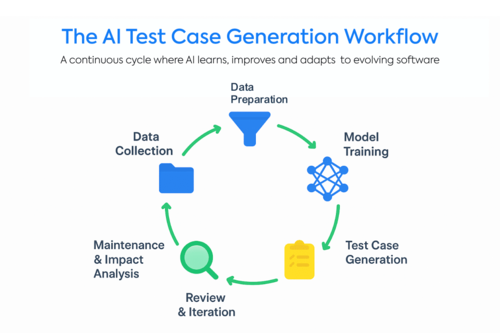
AI Test Case Generation is an automated process that uses machine learning and natural language processing to design software validation scripts without requiring manual human writing. Instead of forcing a quality engineer to sit down and type out individual code steps, an intelligent testing engine ingests your existing corporate data assets to understand how the software is supposed to behave.
The system processes multiple standard engineering inputs to map out verification paths:
- Natural language requirements, user stories, and acceptance criteria.
- API specifications, data schemas, and internal framework documentation.
- Existing manual testing portfolios and historical regression test suites.
- Production telemetry logs, system trace files, and live user journey maps.
- Historical bug reports, defect logs, and past application vulnerabilities.
By analyzing these inputs, the model recognizes the underlying business logic and automatically generates functional tests, automated regression test cases, and hidden edge scenarios. Furthermore, the platform applies risk-based prioritization to rank which tests should execute first based on recent code modifications. This automated process ensures that your testing portfolio adapts dynamically whenever a developer updates a repository file, removing the administrative burden of test creation.
3. The First Real Advantage of AI Test Case Generation
Moving from Fragmented Checklist Volume to Intelligent Protection Quality
When evaluating an automation rollout, engineering leaders must recognize that true test coverage optimization is not measured by the absolute number of tests sitting in a repository. A development team can easily maintain a portfolio of one thousand identical, basic scripts yet still suffer from a high defect leakage rate if those scripts miss critical logic components. True quality means ensuring that your verification matrix actively guards high-risk business behaviors and core revenue-driving user journeys.
This is where an intelligent testing layer delivers a major competitive advantage over traditional methods. In a manual environment, a quality assurance team might have the capacity to draft seventy distinct test scenarios for a complex feature upgrade. By deploying an intelligent engine, the system can parse the same requirements to instantly generate more than four hundred unique, data-driven variations.
Crucially, the platform does not simply dump all four hundred files into your CI/CD pipeline, which would slow down your deployment velocity and waste cloud compute resources. Instead, it analyzes code change impact data to select and execute the top eighty scripts required to achieve absolute release confidence. This combination of high-volume generation and intelligent selection allows enterprise teams to maximize software quality assurance while keeping execution loops fast and cost-effective.
4. Edge Case Discovery: Where AI Test Case Generation Performs Better Than Humans
Machine learning models do not suffer from this behavioral bias; they explore variations across multiple data layers simultaneously. During the automated script design phase, an intelligent platform systematically tests unexpected conditions that a human reviewer might never consider.
Consider the difference in how an automated generation engine scans common enterprise features:
- Checkout Workflows: While a human tester checks standard credit card submissions, the algorithm generates variations combining expired session tokens, simultaneous payment retries, simulated cloud network latency, and invalid database states.
- Identity Authentication Gates: The system cross-references login requests with concurrent session timeouts, malformed API headers, character-set injections, and rapid multi-device login events.
This capability allows organizations to discover hidden vulnerabilities before code ever hits a production branch. The system excels at exposing complex design flaws across integrated microservices that manual script writing routinely misses. However, while an algorithm is highly effective at uncovering these hidden software risks, your core engineering leads must still validate the output to ensure the recommendations match actual corporate logic standards.
5. Building an AI Test Case Generation Automation Workflow
Embedding Algorithmic Design Into Your Secure Core Pipeline
To deliver sustainable value across an enterprise infrastructure, intelligent test automation cannot function as an isolated, standalone tool. If your developers must manually copy and paste machine-generated scripts into their text editors, the process simply adds administrative friction. Realizing release acceleration requires embedding your automated test design steps directly into your primary development lifecycle.
A mature, hybrid testing pipeline operates as a continuous loop:
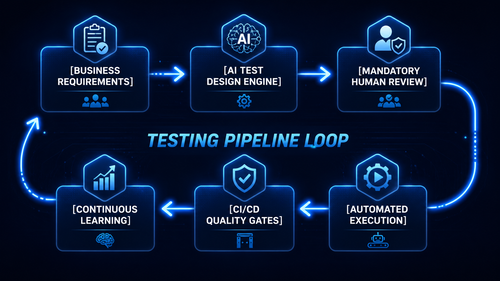
The process begins the moment a product manager updates a user story or an engineer commits a code change. The automated generation engine reads the updated parameters to construct the appropriate functional and regression test scenarios. Before these scripts hit your repository, they enter a mandatory human review interface where your quality architects validate their business relevance.
Once approved, the scripts merge directly into your CI/CD lines, executing alongside deterministic validation tools like static security scanners and dependency trackers. The performance data and failure logs from these execution loops are then fed back into the engine, allowing the model to continuously improve its prioritization rules for the next release cycle.
6. Why AI Test Case Generation Fails in Enterprise Environments
Most enterprise automation rollouts do not slow down because the underlying model architecture is weak. They fail because corporate management attempts to run high-speed generation engines without establishing clear engineering discipline. Avoid these five critical deployment mistakes:
- Attempting to Generate Everything Everywhere: Flooding your repositories with thousands of auto-generated scripts for highly unstable, changing user interfaces creates a massive wave of fragile test code that breaks constantly, causing severe pipeline blockages.
- Operating Without Human Code Ownership: Treating machine-generated output as a final decision without requiring peer human validation results in a bloated backlog filled with irrelevant test scenarios and confusing false alarms.
- Feeding the System Poor Corporate Requirements: Algorithmic models operate on a basic data principle: poor inputs yield poor outputs. If your internal user stories lack clear acceptance criteria and clean data structures, the generated scripts will be highly inaccurate.
- Evaluating Output Volume Over Business Outcomes: Tracking vanity metrics like the sheer number of test files compiled rather than monitoring lagging quality indicators like your post-release defect escape rate.
- Ignoring Long-Term Test Maintenance Scales: Failing to configure automated self-healing layers to update element locators when software components evolve, which quickly buries your quality assurance team under immense maintenance debt.
7. AI Test Case Generation vs Human QA: Evaluating Team Capabilities
Mapping Out Machine Velocity and Human Domain Expertise
Evaluating your validation pipeline requires understanding what machine models handle best and where human engineering judgment must maintain final authority. A successful corporate platform does not attempt to make algorithms and human testers compete; instead, it deploys a shared framework that maximizes the strengths of both layers.
The safest, highest-ROI enterprise model organizes testing responsibilities across clear functional capabilities:
- Generation Velocity & Text Compilation: Exceptional fit for machine intelligence. An algorithm can build and structure thousands of data-driven variations in seconds, eliminating routine drafting tasks from your pipeline.
- High-Volume Test Coverage: Strong fit for automated tools, which can analyze code changes to scan complex integration points across multiple microservices simultaneously.
- System Context & Business Logic Validation: Highly limited for machine models. Human quality engineers must own this layer because they understand the product intent, consumer psychology, and long-term brand strategy.
- Risk Assessment & Release Sign-Off: Suitable for human engineers only. An algorithm cannot hold corporate or legal liability for system stability; final release approval must remain human-directed.
- Regression Suite Maintenance: Shared responsibility. While automation can perform first-pass self-healing repairs on broken locators, human leads guide the overarching testing strategy.
8. What Metrics to Measure After Adopting AI Test Case Generation
To satisfy financial oversight and prove clear business value, an enterprise performance dashboard must focus on lagging delivery and engineering outcomes:
- Defect Escape Rate: Has the volume of critical software bugs or logic flaws slipping past your quality gates into live production environments dropped?
- Test Maintenance Hours: Are your senior quality engineers spending fewer hours manually updating fragile test scripts and repairing broken element locators?
- Regression Cycle Duration: Is the total time required to execute full validation sweeps before a major software rollout decreasing?
- Developer Wait Time: Has the feedback loop shortened, allowing developers to see verification logs minutes after a code commit?
- Release Frequency: Has your organization safely expanded its capacity to ship deployable code to the market more frequently?
9. Global Market Impact on AI Test Case Generation
For multinational technology companies, software validation is an essential component of corporate compliance and risk management. When systems process sensitive data or operate in highly regulated sectors, your testing pipelines must remain completely transparent, secure, and auditable across all operating regions.
Distributed technical units must manage distinct geographic regulations:
- The Swiss Landscape: Operating within trust-heavy sectors like private banking, wealth management, and medical technology requires absolute system resilience under strict FINMA oversight. Automated testing workflows must maintain clear data lineage logs, ensuring that machine-generated code blocks do not introduce untraceable data-handling paths.
- The European Union: Technology groups serving European clients must directly align their pipelines with data protection laws and the phased enforcement milestones of the EU AI Act. As an extra layer of governance, the Act applies to global firms if their automated outputs impact individuals within the EU. Testing models must generate clear conformity logs and preserve human-in-the-loop overrides for high-risk applications.
- The United States & UK: Development units face immense pressure from corporate boards to align their secure software development lifecycle with the NIST Risk Management Framework, demanding strict secure API validation and transparent threat modeling.
10. How IMT Approaches AI Test Case Generation and Quality Engineering
Intelligent test automation delivers real business leverage only when it operates within a mature, disciplined software delivery lifecycle. Setting up a secure hybrid pipeline demands extensive technical expertise in data modernization, automated testing, secure system integration, and global risk compliance.
IMT Solutions serves as a trusted digital transformation and product engineering partner, helping enterprises design, execute, and optimize modern technical frameworks under strict ISO 27001-certified security requirements. Closely aligned with our core automation frameworks outlined in AI in DevOps, we optimize your software lifecycle.
If your software delivery pipeline is acting as a major release bottleneck, or your teams are losing focus time manually scripting basic tests, it is time to upgrade your testing framework. An independent readiness review can help your leadership team optimize DevOps workflows, improve automated testing coverage, mitigate technical debt, and establish real value verification before you scale spending further. Explore our latest integration approaches in Blogs – IMT Solutions, analyze our live delivery history in Case Studies – IMT Solutions, or connect with our platform specialists at Contact IMT Solutions to advance your software lifecycle with absolute confidence.
11. Conclusion
AI Test Case Generation is not about eliminating your quality assurance department. It is about removing the repetitive manual drafting work that prevents your engineering teams from operating at scale. The organizations that capture a sustainable competitive advantage will not be those that hand out the highest volume of software licenses or blindly trust machine-generated scripts. The long-term winners will be the companies that combine algorithmic execution speed with mature human judgment, risk-based prioritization, and clear process discipline. If your teams are currently spending more time writing test scripts than validating actual product quality, it is time to rethink how your testing is designed.
FAQ
Can AI generate software test cases?
Yes, AI can automatically generate comprehensive software test cases by parsing natural language requirements, user stories, acceptance criteria, source code structures, and production logs.
Does AI replace manual QA engineers?
No. AI removes repetitive drafting work and accelerates pattern analysis, but human quality engineers remain essential for managing test strategy, validating complex business logic, conducting exploratory testing, and owning final release approval.
Is AI testing suitable for enterprise systems?
Yes—but governance, security boundaries, and workflow integration matter intensely. Enterprise implementations require linking automated generation engines with robust CI/CD lines and strict human review gates.
What are the primary risks of AI-generated testing?
The main risks include false confidence from unverified scripts, code maintenance debt from automating unstable user interfaces, duplicate test generation, and poor input requirements leading to inaccurate outputs.
How does AI Test Case Generation expand test coverage safely?
The platform generates thousands of data-driven script variations to uncover hidden edge cases, but then employs change impact analysis to select and run only the high-risk tests required, preserving pipeline speed.
What metrics should technology leaders track to measure AI testing ROI?
Success must be evaluated through lagging system outcomes, including defect escape rate reduction, a contraction in manual test maintenance hours, shortened regression cycle durations, and faster time-to-feedback for developers.