Product Scalability: The Architecture Decisions That Matter Early
Most products don’t break at 100 users. They break at 100,000.
By then, the team is a year into the product. Customers are paying. The roadmap is full. Nobody planned for a rebuild.
But the database is timing out under concurrent writes. The monolith that shipped the MVP in six weeks now takes six days to deploy safely. Every new feature breaks something unrelated.
This isn’t bad luck. It’s the direct result of decisions made when the product was small – decisions that felt correct at the time. Nobody chose to build something fragile. They chose to build something fast, and fast and fragile often look identical for the first year.
Product scalability is not something you retrofit after growth arrives. It’s a set of architecture decisions made early – often in the first 90 days. Those decisions determine whether growth compounds into value or into a rebuild.
You’re past the “just ship it” phase. You need to know which product scalability decisions matter now, and which ones can safely wait.
What Product Scalability Actually Means
Quick answer:
Product scalability is the ability of a product’s architecture to handle growth in users, data, and transactions without a proportional rise in cost or downtime. It isn’t a fixed feature. It’s a series of decisions that should evolve as the product grows.
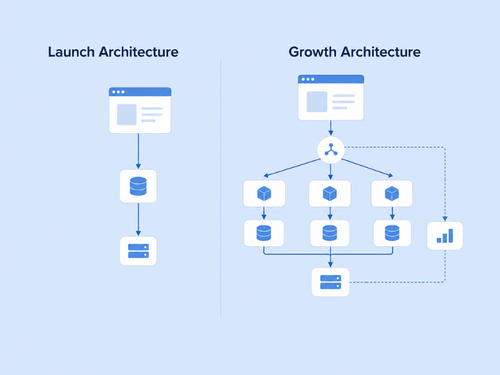
Launch-ready and scale-ready are not the same thing. Launch favors speed. A single codebase. The fastest path to customer feedback. Scale favors resilience – separation of concerns, and predictable performance under load.
Early-stage teams are right to prioritize speed. A startup that spends six months building fault-tolerant architecture before it has customers has made the wrong trade. Shortcuts at launch aren’t a mistake. They’re the correct call for a team that doesn’t yet know if the product will survive contact with the market.
The mistake isn’t taking the shortcut. It’s not knowing which shortcuts are reversible – and never revisiting the decision once growth starts. That’s where product scalability planning has to begin.
| Launch priorities | Growth priorities |
|---|---|
| Fastest path to customer feedback | Ship changes without breaking unrelated features |
| Single codebase, single database | Separated services, workload-appropriate data stores |
| Manual processes are acceptable | Manual processes become the bottleneck |
| Uptime matters, but isn’t existential | Downtime has a direct, visible cost |
| Founders make most technical calls | Decisions need to scale beyond the founding team |
Neither column is “correct.” The failure mode is staying in the launch column after growth has already arrived.
Where SaaS Scalability Breaks Down in Practice
Quick answer:
Most product scalability failures come from a handful of repeat causes. These include databases that can’t handle concurrent load, tightly coupled services, tenancy models bolted on later, and missing observability. They rarely fail all at once – they build slowly until growth exposes them.
A review of startups that hit a scalability wall found the same gaps across most codebases. Not exotic bugs. Foundational choices nobody revisited as the product grew.
- Single-tenant assumptions in the schema. Adding multi-tenancy after the data model assumes one customer per database is a rebuild, not a config change. Most teams discover this the day a second enterprise customer asks about data isolation.
- Tightly coupled, synchronous services. One slow dependency degrades the whole product. The blast radius grows with every feature added, and nobody notices until an incident spans three teams instead of one.
- No caching or query strategy. Queries that were fast at 1,000 rows fail at 10 million – usually without warning, and usually during the traffic spike you were hoping for.
- Missing observability. Teams that can’t see what’s failing debug blind, exactly when they can least afford it. Every incident becomes a manual investigation instead of a quick fix.
- Manual, undocumented deployments. A process that depends on one engineer’s memory doesn’t survive team growth, on-call rotations, or that engineer taking a vacation.
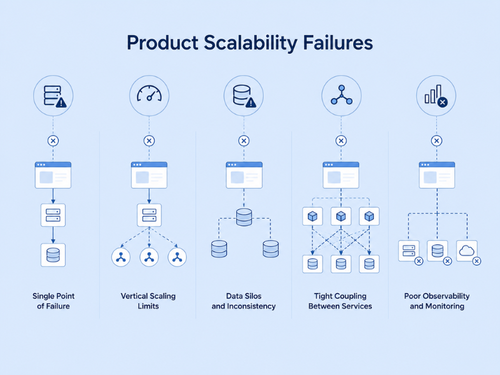
Most of these bottlenecks are invisible until growth exposes them. A product with 500 users and one with 50,000 can run identical code. The gap shows up the moment a single query or dependency turns a smooth release into a stalled one.
This is what product scalability planning is meant to catch early. For a closer look at how these gaps surface in AI-augmented delivery pipelines, our AI Software Delivery article covers where automation helps – and where it adds new risk.
How Architecture Decisions Should Evolve by Growth Stage
Quick answer:
Product scalability isn’t a fixed target you build once. It’s a series of decisions that change as the product moves from finding product-market fit to defending it at scale. What’s right at each stage is different.
Stage 1: Before product-market fit
Optimize for learning speed. A monolith, one database, and manual processes are fine here. The biggest risk is over-building for scale the product may never need.
Stage 2: After product-market fit, before enterprise scale
This is where most product scalability decisions start to matter. These are system design decisions about coupling, data ownership, and observability. Decouple the parts of the system growing fastest. Add basic monitoring. Revisit any data model assumption built for one customer at a time. None of this requires a full rewrite – it requires picking the two or three components under the most growth pressure and fixing those first.
Stage 3: Enterprise and regulated scale
Compliance and data residency move from nice-to-have to contract requirement. We see this consistently with clients selling into EU, Swiss, and US enterprise buyers. Redundancy, audit trails, and formal change management stop being optional here.
Our Enterprise AI ROI article goes deeper into how enterprises evaluate technology investment at this stage.

The Real Cost of Waiting Too Long
Quick answer:
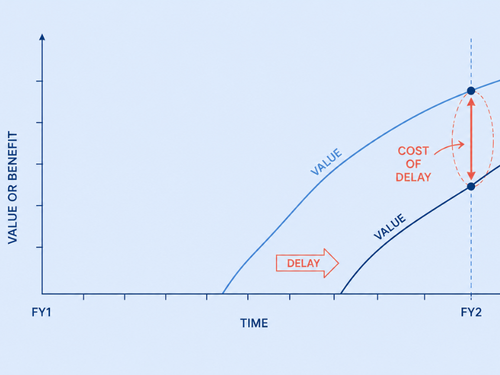
Delaying product scalability decisions doesn’t remove the cost. It moves the cost later and makes it bigger. Startup Genome found that 74% of high-growth internet startups fail specifically because of premature scaling.
Technical debt doesn’t build at a steady rate. The first few months feel fine. Then velocity quietly drops as engineers work around old decisions instead of shipping new ones. By the time leadership notices the slowdown, the cause is usually 12 to 18 months old.
The visible cost is a rebuild – weeks or months spent rebuilding something that already worked. The invisible cost is worse. Features that never shipped. An enterprise deal that stalled during a security review. An engineer who left because every sprint felt like firefighting.
It’s a common pattern: a data model rebuild gets delayed for a year because there’s always a more urgent feature. Then an enterprise procurement review asks how customer data is isolated, and the honest answer isn’t good enough. The fix that would have taken weeks a year earlier now takes months, under deal pressure, with a signed contract on the line.
Neither cost shows up on a roadmap slide. Both show up in board meetings – usually the ones where product scalability was never on the agenda.
What Founders and CTOs Should Ask Before They Scale
Quick answer:
Before the next stage of growth, leadership should be able to answer a short set of concrete questions about product scalability. If more than one answer is “we’re not sure,” that’s the signal to review architecture before investing further in growth.
- Can we onboard an enterprise customer without a manual engineering task? If onboarding needs a developer to touch code by hand, that’s a scaling bottleneck – and it gets worse, not better, as the sales team closes more deals.
- Do we know where the system will break before a customer tells us? Without observability, the customer becomes your monitoring system, and that’s an expensive way to find out about a problem.
- Can we ship a feature without three engineers reviewing unrelated modules? That’s a coupling problem, not a process one, and adding more reviewers won’t fix it.
- What happens to our data model if our biggest customer gets 10x bigger? This question surfaces single-tenant assumptions early, before a contract depends on the answer.
- Could we pass a technical review from an enterprise procurement team today? EU and Swiss buyers increasingly ask this before signing, not after.
How IMT Solutions Supports Product Scalability
IMT Solutions works with founders and enterprise engineering teams across BFSI, healthcare, and enterprise software. We help them make architecture decisions that hold up under growth, not just at launch. Our approach starts with an honest audit of where the system will break. Then we prioritize fixes that matter over fixes that are merely convenient.
If you’re evaluating product scalability before your next growth stage, explore our case studies or contact our team to talk through where your system stands.
Frequently Asked Questions
What is product scalability?
Product scalability is a product architecture’s ability to handle growth in users, data, and transactions without a proportional rise in cost, downtime, or engineering effort. A scalable product can grow tenfold without a rebuild. A non-scalable one hits a wall where every increment of growth costs more than the last.
When should a startup invest in scalable software architecture?
Not at launch, and not never. The right time is after product-market fit, once growth is real and predictable. Investing in scalable software architecture before product-market fit usually means building for a version of the product that never ships.
What’s the difference between technical debt and scalability debt?
Technical debt is any shortcut that trades long-term maintainability for short-term speed. It can exist in a product that never needs to scale. Scalability debt is the subset that specifically breaks under growth. It comes from assumptions about data volume or tenancy that were fine for the first hundred customers – and fail for the next hundred thousand.
How do EU and Swiss compliance requirements affect SaaS scalability planning?
Enterprise buyers in the EU and Switzerland typically require evidence of data residency controls and audit trails before signing. These are far cheaper to build into system design decisions at Stage 2 or 3 than to retrofit after a deal is already on the table.
How do I know if my product needs a scalability audit now?
Three signs are worth acting on immediately. Feature releases routinely take longer than they used to. On-call engineers are firefighting the same class of incident, again and again. Enterprise prospects are asking security or compliance questions your team can’t answer with confidence. Any one of these is a reasonable trigger for a focused architecture review before the next growth push.