AI Architecture Decisions: How to Catch Hallucinations Before They Ship
AI shouldn’t decide your architecture alone.
That’s not a warning for junior developers experimenting with a chatbot. It’s a structural fact about AI-augmented engineering. AI tools are excellent at implementing known patterns. They are unreliable at choosing between them. Architecture is nothing but choosing.
Every AI architecture decision is a judgment call about tradeoffs – a queue here, a data store there, a trust boundary somewhere else. A model can describe that judgment call fluently. It has no real grasp of what it costs your system six months later.
You’re past the “AI writes my boilerplate” conversation. The harder question: how do you catch a hallucinated AI architecture decision before five other teams build on top of it?

Why AI Architecture Decisions Need a Human Check
Quick answer:
AI architecture decisions look identical whether they are right or wrong. The model produces the same confident output either way. Without a validation step, the only thing separating a sound AI architecture decision from a hallucinated one is whether someone with system context happened to catch it.
Code-level hallucinations usually announce themselves. The build fails. A test breaks. A linter complains.
AI architecture decisions don’t get that safety net. A model can recommend a pattern that compiles fine and passes every test. It can still be the wrong choice for your system. Nothing in the pipeline will flag that for months.
This is the hardest part of AI-augmented engineering to govern. Architecture decisions sit one level removed from the code that implements them. The model isn’t wrong about syntax – it’s wrong about fit. And fit is exactly what a model has the least visibility into. It’s the same reason AI code review has to extend beyond syntax checks into judgment territory.
There’s data on how often this kind of confident fabrication happens elsewhere in the stack, and it isn’t reassuring. Researchers at the University of Texas at San Antonio tested sixteen widely used code-generating models. Roughly one in five recommended packages didn’t exist at all. The models described libraries with full confidence that had never been built, across 576,000 generated code samples in a USENIX-published study.
If models fabricate at that rate on something as checkable as a package name, expect no better at the architecture level. Whether a pattern fits your team and your constraints is far harder to verify automatically.
Common Hallucinations in AI Architecture Decisions
Quick answer:
The most common hallucinations in AI architecture decisions are pattern mismatches (recommending a pattern that doesn’t fit team size or load), fabricated performance guarantees, invented compliance compatibility, phantom or deprecated dependencies, inconsistent paradigm mixing, and context collapse across long design conversations.
Most teams making AI architecture decisions have already hit one of these patterns.
- Pattern mismatch. A model recommends microservices for a five-person team, or event sourcing for a workload that never needed it. The pattern is real. It just doesn’t match your team size or traffic.
- Fabricated non-functional guarantees. “This design handles ten thousand requests per second,” stated with total confidence and zero grounding in your actual infrastructure.
- Invented compliance compatibility. A model declares a design “GDPR-compliant” with no basis for the claim. In regulated industries, this is one of the most dangerous hallucinations – it sounds like a fact someone already checked.
- Phantom dependencies and deprecated patterns. The architecture leans on a library or integration pattern that’s deprecated, sunset, or never existed.
- Paradigm mixing without consistency. Event-driven async patterns combined with tightly coupled synchronous calls, creating failure modes nobody designed on purpose.
- Context collapse in long design conversations. A recommendation late in a chat quietly contradicts a constraint the model agreed to twenty messages earlier.

What Hallucinated AI Architecture Decisions Cost You Later
The damage from a hallucinated AI architecture decision rarely shows up right away. That’s what makes it expensive.
Technical debt that compounds invisibly. Each AI architecture decision looks reasonable on its own. The problem is structural: choices optimised for the local problem, not the system as a whole. This flavour of AI technical debt tends to surface as an unbudgeted refactor, six to twelve months later.
Cross-system coupling nobody intended. A hallucinated integration pattern can quietly couple two services that should never have known about each other. By the time it’s visible, three more services depend on the same shortcut.
Compliance exposure with no audit trail. In regulated industries, a decision touching sensitive data needs a documented rationale. An AI architecture decision adopted without review leaves no record of who approved it. That’s a real gap under EU AI Act human oversight rules for high-risk systems.
Erosion of trust in either direction. Teams burned once by a hallucinated AI architecture decision tend to overcorrect. Some ignore AI input entirely, losing the speed gain. Others rubber-stamp it out of fatigue, which is worse. We cover this broader pattern in our article on why enterprise AI fails in production.
Architecture Validation: A Practical Framework for AI Architecture Decisions
Quick answer:
Architecture validation for AI architecture decisions comes down to five checks: does it fit your real constraints, does it match existing patterns, how much does it touch if wrong, can it be undone, and is the rationale documented (architecture decision record)?
Validating AI architecture decisions doesn’t require slowing every decision to a crawl. It requires asking the same five questions, every time.
- Constraint check. Does this fit your real team size, stack, and traffic – not the generic case the model trained on?
- Precedent check. Is this pattern already used elsewhere in your system, or does it quietly introduce a second paradigm?
- Blast-radius check. If this AI architecture decision turns out wrong, how many services or data paths does it touch?
- Reversibility check. Can this be undone cheaply next quarter, or is it a one-way door?
- Documented rationale. What alternatives did the model consider, and why was this one chosen?
That fifth question is where architecture decision records earn their place. Architecture decision records (ADR) predate AI by years. They’re exactly the tool that closes the gap AI opens. An ADR captures the context, the alternatives, and the decision – in writing, before the code ships.
When the proposal comes from an AI tool, the ADR becomes something more. It’s where a human states, on the record, why they accepted or rejected it. That single habit turns an AI architecture decision into something that can be audited and reversed if it’s wrong.
Design Review Frameworks for AI Architecture Decisions
Validation answers whether one decision is sound. Design review frameworks answer who needs to look at AI architecture decisions, and when.
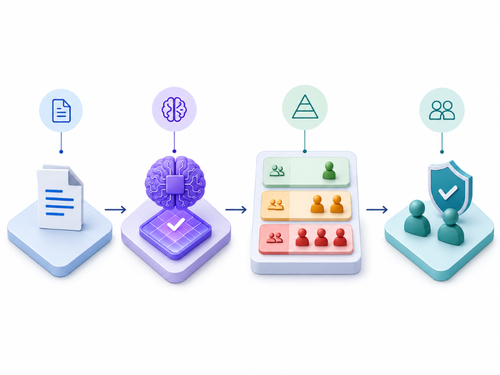
Tiered review by blast radius. Not every AI architecture decision needs a full review board. A naming convention can clear with a lightweight async check. A decision touching a shared data store or a customer-facing API needs full software architecture review before it merges. Scrutiny should scale with risk, not apply uniformly.
Require alternatives, not just answers. Prompt AI tools to surface the options they rejected, not only the final recommendation. A proposal with no visible alternatives is a red flag, whether it came from a model or a junior engineer.
Two-person sign-off on regulated paths. Any AI architecture decision touching GDPR-covered data or financial reporting should require sign-off from two people with system context. The cost of being wrong there is asymmetric.
AI pre-screens, humans decide. AI tools can flag when a proposal conflicts with an existing architecture decision record. That pre-screening speeds up software architecture review without removing the human judgment call at the end. It’s the same principle behind AI code review across AI-augmented engineering: AI prepares the ground, a human makes the call.
Compliance-Safe AI Architecture Decisions in Regulated Industries
For leaders in financial services, healthcare, and enterprise software, validating AI architecture decisions isn’t only an engineering discipline. It’s a regulatory one.
The EU AI Act requires human oversight mechanisms for high-risk AI systems, and that obligation doesn’t stop at the code level. An architecture decision shaping how a high-risk system handles or logs data is part of what regulators expect documented.
DORA adds another layer for financial institutions. ICT systems – and the architecture decisions behind them – need to be tested, documented, and recoverable from disruption. A new dependency or failure mode is exactly what DORA expects an institution to explain.
For enterprises across Germany, France, the Netherlands, and the broader EU, national supervisors are extending these expectations into day-to-day engineering governance. Architecture choices are increasingly something auditors ask about directly.
For Swiss institutions, FINMA’s guidance tracks closely with these EU standards. Swiss organisations serving EU clients are generally expected to meet the same bar. The same holds for US enterprises with EU exposure. A documented, reviewable trail behind every AI architecture decision is fast becoming the baseline.
The data infrastructure underneath this is its own discipline – how decisions get logged and made auditable. We cover it in our article on AI data infrastructure and compliance.
What Leaders Should Do About AI Architecture Decisions Right Now
For CIOs, VPs of Engineering, and architects, here is the sequence for governing AI architecture decisions that holds up across regulated and unregulated environments alike.
- Require an ADR for every AI architecture decision above a defined blast radius. Set the threshold now – by data sensitivity, system criticality, or both – rather than during an incident review.
- Build a tiered review gate into your design process. Not every decision needs the same scrutiny. Define what qualifies for lightweight review before anyone skips it under deadline pressure.
- Ask AI tools for alternatives, every time. Make “what did you consider and reject” a standard prompt, not an occasional courtesy.
- Track AI technical debt like any other debt. If a decision ships with a known shortcut, log it, assign an owner, and revisit it on a schedule.
- Audit your architecture for AI-originated decisions nobody reviewed properly. Most teams have at least a handful. Finding them now is cheaper than finding them during an outage.
How IMT Solutions Strengthens AI Architecture Decisions
IMT Solutions works with engineering organisations across financial services, healthcare, and enterprise software. We build architecture governance that holds up under AI-assisted velocity and regulatory scrutiny alike. Every AI architecture decision gets validated, documented, and reviewed at a level proportionate to its risk – not treated as a shortcut that bypasses judgment.
Building review infrastructure for AI-assisted design, or auditing decisions already in production? Explore our case studies or contact our team to talk through your environment.
Frequently Asked Questions About AI Architecture Decisions
What is a hallucinated AI architecture decision?
A hallucinated AI architecture decision is a design recommendation that sounds plausible but doesn’t actually fit the system it was proposed for. It might be a pattern mismatched to team size, a fabricated performance guarantee, or an unfounded compliance claim. It’s dangerous because it’s indistinguishable in tone from a correct recommendation. The only reliable defence is a validation step that checks the decision against real constraints, not the model’s confidence.
How common are hallucinations in AI-generated code and architecture?
Hallucinations are well documented at the code level. A USENIX-published study found that roughly one in five third-party packages recommended by sixteen code-generating models did not exist. Architecture-level hallucinations aren’t measured at that scale yet, but the cause is the same: models describe plausible patterns without verifying fit. The risk is arguably higher at the architecture level, where no compiler catches the error automatically.
What is an architecture decision record and why does it matter for AI?
An architecture decision record (ADR) is a short document capturing the context behind a design choice, the alternatives considered, and the final reasoning. For AI architecture decisions specifically, the ADR is where a human records why they accepted or rejected a model’s recommendation. That turns a suggestion into a documented, auditable decision, not an unreviewed shortcut.
Does the EU AI Act apply to AI-generated architecture decisions?
Yes, indirectly but materially. The EU AI Act requires human oversight mechanisms for high-risk AI systems. Architecture decisions that shape how such a system handles or logs data fall within what regulators expect documented. An AI architecture decision adopted without review or rationale is a gap in exactly the oversight the Act requires.
How should teams design review gates for AI-generated architecture proposals?
Review gates should scale with blast radius, not apply uniformly. Low-impact AI architecture decisions – naming conventions, internal-only endpoints – can clear with a lightweight async review. Decisions touching shared data stores or regulated workloads need a full design review, plus sign-off from two people in regulated settings. The goal is proportionate scrutiny, not scrutiny on every decision.