Human-in-the-Loop AI: Designing Development Workflows
Who approves AI-generated code before it reaches production?
In most engineering teams right now, the honest answer is: it depends. Sometimes a senior engineer. Sometimes whoever’s on review duty. Sometimes just the pipeline – if the tests pass.
That’s the core problem. As AI tools take on more of the code generation workload, the governance structure around that code has not kept pace. The result is not that AI writes bad code. It’s that nobody has clearly defined who is responsible for signing off on it, at what point, and with what authority to stop or escalate.
If you are building or rebuilding your AI-augmented development process in a regulated environment, this is the operational architecture that makes it defensible – to your team, your auditors, and your regulators.
Quick answer:
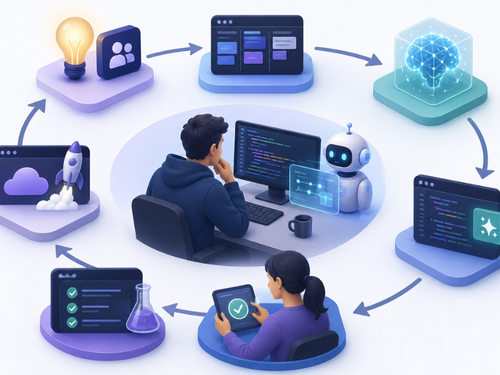
A human-in-the-loop AI workflow is an engineering process where human judgment is embedded at defined checkpoints in the AI-assisted development pipeline. Not at every step – that eliminates the efficiency gain. At the specific stages where AI output carries the most consequential risk: security-sensitive code, compliance-critical changes, architecture decisions, and production deployments.
Why Structure Matters More Than the Tooling Decision
Most engineering teams adopting AI tools focus heavily on the tooling question – which copilot, which model, which IDE integration. The human-in-the-loop AI governance question usually comes second, if it comes at all.
That sequencing is the problem.
AI tools are very good at generating code that looks correct. The issues that matter most – security vulnerabilities, architectural anti-patterns, compliance boundary violations – tend to be invisible at the PR level. They require context that the AI does not have and developers under velocity pressure do not naturally stop to apply.
When you do not define the HITL structure before deploying the tools, review becomes informal. Informality under volume means things get through that should not. And in a regulated environment – financial services, healthcare, enterprise software – ‘things got through’ is the beginning of a much longer, more expensive conversation.
The structure is not there to slow AI down. It is there to make the speed sustainable.
A 2024 Stanford study on AI coding assistants found developers using these tools were more likely to introduce security vulnerabilities than those working without them – not because the AI was malicious, but because speed reduced the attention applied to security review. Volume without structure is where the liability lives.
The Four Stages of a Human-in-the-Loop AI Development Workflow
A well-designed human-in-the-loop AI development workflow has four distinct stages. Each stage has a defined owner, a defined input, and a clear exit condition. These are not bureaucratic checkboxes – they are operational handoffs.
Stage 1: Requirement and Context Intake
AI generates code based on the prompt it receives. The quality and specificity of that prompt determines not just functional output, but architectural and compliance quality. Teams that skip this stage are not saving time – they are loading technical and compliance debt into later review cycles where it is harder and more expensive to catch.
Stage 2: AI-Assisted Generation with Guardrails
This is the AI’s primary working stage. Engineers use AI tools to generate code, suggest implementations, and accelerate development. The governance elements here are configured, not manual.
Guardrails at this stage include:
- Approved model lists: No consumer LLMs for proprietary code. Enterprise-grade tools with data residency compliance only.
- Prompt logging: Where required for audit – particularly for changes to compliance-critical modules.
- Sensitive module flagging: Pipeline or IDE-level triggers when AI output touches high-risk areas.
The goal is not to restrict AI output. It is to make the generation context visible to the AI code review stage that follows.
Stage 3: Tiered Human Review
This is the most operationally complex stage and the one most teams design inadequately.
Not all AI-generated code carries the same risk. A PR generating CRUD endpoints for internal tooling is a different review requirement from a PR modifying authentication logic or a payment processing flow. Treating them identically creates one of two problems: reviews become bottlenecks, or they become rubber stamps.
Tiered review resolves this by matching review depth to risk profile:
| Risk Tier | Code Domain | Review Requirement |
|---|---|---|
| Tier 1 – Standard | Boilerplate, test generation, documentation, styling | Standard review process. No AI-specific governance overlay required. |
| Tier 2 – Elevated | Feature logic with external integrations, Database schema changes, API contracts | Named senior reviewer with explicit written sign-off. |
| Tier 3 – Human Ownership Required | Auth, encryption, payment logic, GDPR data handling, regulated workflows | Designated engineer sign-off. Not the PR author. Logged and auditable. |
Stage 4: Production Approval Gates
For standard code, this stage is routine. For compliance-critical changes or agentic AI actions – triggering deployments, modifying configurations, executing rollbacks – it requires a named human sign-off, logged in a way that survives an audit.
That audit trail is what regulators look for. It is also what incident response depends on.
AI Code Review Checkpoints: What Reviewers Are Actually Validating
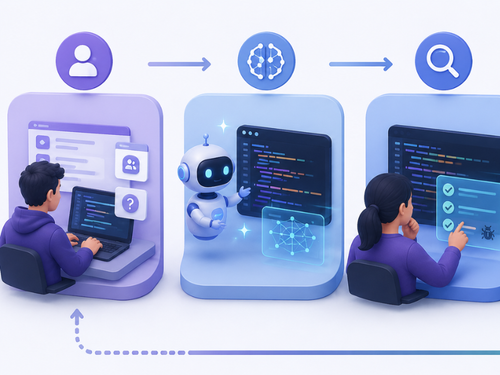
The tiered model works in theory. Making it operational in a human-in-the-loop AI setup requires defining what each tier’s checkpoint is actually doing – not just who conducts it.
For each tier, define:
- Who reviews: Named role, not ‘any senior engineer.’
- What they validate: Specific criteria – security analysis for Tier 3, not general code quality.
- Exit condition: What explicit action constitutes approval? A comment? A merge gate? A logged ticket?
- Where it is recorded: Where does the review decision live for audit purposes?
For Tier 3 changes specifically, the code review process should include a structured security and compliance review – separate from the functional review. The reviewer is validating that AI-generated output does not introduce vulnerabilities or compliance violations. These are different tasks from checking whether the code meets the feature spec, and conflating them is how security vulnerabilities clear review in large, fast-moving codebases.
In regulated sectors – financial services under DORA, healthcare under HIPAA or local equivalents, or enterprise software subject to EUAI Act high-risk classification – Tier 3 review documentation is compliance evidence. Not a formality.
Escalation Models: Designing for Scenarios You Have Not Seen Yet
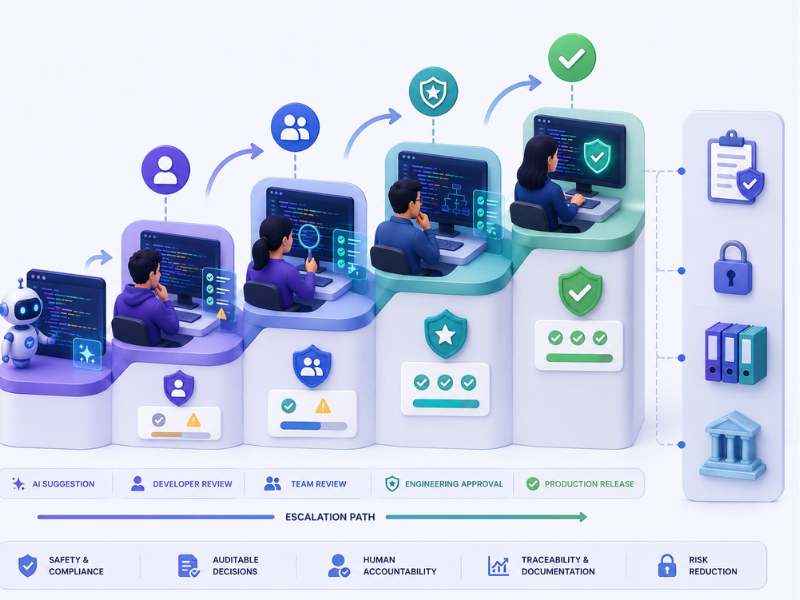
Escalation paths are the part of human-in-the-loop AI workflows that almost nobody designs in advance – until something goes wrong.
The requirement is straightforward: every scenario where AI-generated output might fall outside expected parameters should have a predefined response. The improvised version always takes longer, creates accountability gaps, and costs more.
Common escalation triggers to define in advance:
- Automated security scan flag on an AI-generated PR: Who receives it, who decides whether to proceed, what is the hold threshold?
- Agentic AI action in production encountering an unexpected state: Does it halt automatically? Who is notified? What is the rollback procedure?
- PR touching a compliance-critical module without Tier 3 review: Hard block in the pipeline, or an overrideable warning?
- Confidence threshold below acceptance level: If an AI model is used in decision-support, what confidence score triggers human review instead of automated processing?
- Shadow AI detection: Proprietary code entered into unsanctioned public models – what is the response protocol?
Every escalation path needs three components:
| Component | What It Defines |
|---|---|
| Trigger | The specific condition that initiates escalation – defined in advance, not improvised during an incident. |
| Path | Who gets notified, in what order, through what channel. |
| Outcome | What decision the escalation owner can make and how it is recorded. |
For engineering teams in financial services or healthcare, escalation paths for AI systems should align with existing incident response procedures – not exist in parallel to them. This is an integration task that needs to happen before the scenario occurs.
Regulatory Alignment: EU AI Act, DORA, and FINMA
For engineering leaders operating in regulated markets, designing human-in-the-loop AI workflows is not just an operational decision. It is part of a broader AI risk management obligation – and in many jurisdictions, a direct compliance requirement.
The EU AIAct requires that high-risk AI systems include human oversight mechanisms allowing qualified operators to monitor, intervene, and override AI decisions in real time. For AI deployed in financial services, healthcare, and employment decisions across EU member states, that oversight needs to be in the architecture – not described in a governance document.
DORA extends this for financial institutions: AI systems embedded in operational processes must be tested, documented, and recoverable. The review and escalation structure in your delivery pipeline is part of that ICT risk framework, not separate from it. National supervisors like BaFin in Germany are building AI governance expectations directly on top of DORA, with explicit requirements for AI system inventory and management-level oversight.
For institutions in Switzerland, FINMA‘s guidance aligns closely with EU standards in practice. Banks and insurers using AI in credit decisions, compliance monitoring, or client-facing applications face equivalent human oversight requirements – particularly those serving EU markets.
The practical implication: HITL workflow documentation is audit evidence. Stage definitions, checkpoint criteria, approval logs, and escalation records are the artifacts that demonstrate your AI risk management controls when a regulator asks to see them.
For a deeper look at how human oversight intersects with AI governance requirements, the IMT Solutions blog covers the regulatory landscape in detail.
The Most Common Failure Modes
These are not hypothetical. They are patterns that repeat across enterprise AI deployments in financial services, healthcare, and enterprise software – in Europe and the US.
Governance that only lives in a document
Policy describes the human-in-the-loop AI workflow. The pipeline does not enforce it. Reviews happen informally, approvals are assumed rather than recorded, and escalation paths exist on paper but nobody has tested them. This is the most common configuration in enterprise engineering teams right now.
Review processes not built for AI volume
A review process built for 12 PRs per week breaks when AI enables 60. Either reviews become bottlenecks and developers route around them, or they become rubber stamps and the oversight value disappears. Tiered AI code review gates resolve this – but only if the tiers are defined before the volume pressure arrives.
Agentic AI in production without explicit gates
When AI agents have access to production – triggering deployments, modifying configurations, running rollbacks – the stakes are categorically higher than a PR review. Teams extending AI access to production workflows without explicit approval gates are carrying liability most have not fully quantified.
For a detailed breakdown of the risk profile around agentic AI and enterprise production environments, see our article on why enterprise AI fails in production.
Accountability gaps at incident
When AI-generated code causes a production failure, ‘who approved this?’ needs an answer faster than most accountability structures are designed to provide. If the PR review was informal and the approval was implicit, you do not have an accountability record – you have a record of activity. Those are not the same thing.
For teams working on the broader picture – including how HITL workflows interact with delivery performance metrics and AI software delivery at scale – the relationship between governance design and engineering productivity is something we cover in depth elsewhere in this series.
You can also explore how these workflows connect to AI technical debt and long-term delivery health in our coverage of the hidden costs of AI-generated code.
How IMT Solutions Designs Human-in-the-Loop AI Workflows for Regulated Teams
IMT Solutions works with engineering organisations in financial services, healthcare, and enterprise software to build AI-augmented development environments where human oversight is operational, not aspirational.
That means workflow design, pipeline configuration, checkpoint criteria, and audit infrastructure – built to the regulatory requirements of the markets you operate in. From FINMA-regulated institutions to DORA-covered financial entities across Germany, France, the Netherlands, and beyond.
If you are mapping your governance gaps or building Human-in-the-Loop infrastructure from scratch, explore our case studies or talk to our team directly.
Frequently Asked Questions
What is a human-in-the-loop AI workflow in software development?
A human-in-the-loop AI workflow is a structured development process where human judgment is embedded at defined checkpoints in the AI-assisted delivery pipeline. Unlike informal review, a proper HITL workflow specifies which code domains require human approval, what the reviewer is validating at each stage, and where decisions are logged. In regulated industries, this structure doubles as compliance evidence – demonstrating to auditors and regulators that AI-generated outputs were subject to qualified human oversight before reaching production.
How do you tier review requirements for AI-generated code?
Review tiers should reflect the risk profile of the code domain, not the size of the PR. Low-risk domains – boilerplate, test generation, documentation – follow standard review processes. Mid-risk domains with external dependencies or schema changes require named senior reviewers with explicit sign-off. High-risk domains including authentication, encryption, payment processing, GDPR data handling, and compliance-critical workflows require a designated human owner whose sign-off is logged and auditable. Define these tiers before deploying AI tools – not under the volume pressure that follows.
What triggers escalation in a human-in-the-loop AI workflow?
Escalation triggers should be defined in advance for every scenario where AI output could fall outside expected parameters. Common triggers include automated security scan flags on AI-generated PRs, AI agent encounters with unexpected production states, PRs touching compliance-critical modules without required Tier 3 review, and confidence thresholds falling below acceptance levels in AI-assisted decision workflows. Each trigger needs a named path – who gets notified, in what sequence – and a defined outcome: what decision the escalation owner can make and how it is recorded.
Does the EU AI Act require human-in-the-loop AI workflows?
The EU AI Act requires that high-risk AI systems include human oversight mechanisms allowing operators to monitor, intervene, and override AI decisions. It does not prescribe a specific workflow design, but it does require that oversight be operational and demonstrable – not just described in policy. For AI systems used in financial services, healthcare, employment, or critical infrastructure across EU member states, engineering teams need HITL structures they can show auditors as functioning controls, with evidence of review, approval, and escalation records.