Avoid Product Complexity Debt: Every New Feature Costs More Than You Think
Every new feature creates a maintenance cost that never disappears.
That line sounds obvious once you say it out loud. Most product teams still ship as if it isn’t true.
A feature request comes in. The team scopes it, builds it, ships it. The launch goes well. Nobody schedules a follow-up conversation about what that feature will cost to support, test, and explain a year from now. That cost doesn’t go away. It sits in the codebase, in the support queue, and in every future engineer’s onboarding week.
This is product complexity debt: the accumulated cost of every feature, integration, and edge case a product carries, whether or not anyone still uses it. Unlike technical debt, which engineering teams can usually name and track, complexity debt hides in plain sight – inside the product itself, not just the code behind it.
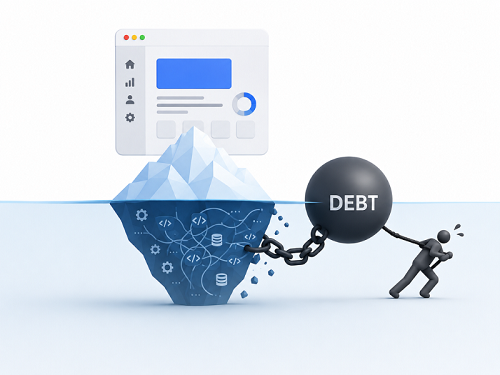
What Is Product Complexity Debt?
Quick answer:
Product complexity debt is the ongoing cost of maintaining every feature, configuration, and workflow a product has ever shipped – including the ones customers barely use. It grows every time a team ships a feature without a plan to support, document, or eventually retire it.
Technical debt lives in code: shortcuts, workarounds, outdated dependencies. Complexity debt lives one level up, in decisions about what the product does and for whom. It shows up in small choices that each feel reasonable on their own:
- Adding a configuration option instead of picking a sensible default
- Building a one-off integration for a single enterprise customer
- Keeping a legacy workflow live “just in case” someone still needs it
- Shipping a second way to do something the product already does, because nobody wants to deprecate the first one
None of these decisions look wrong at the time. Each one is usually a reasonable answer to a real customer request. The debt shows up later – when a new engineer has to learn five ways to update a record instead of one, or a support agent has to remember which of four settings actually controls a customer’s issue.
How Product Complexity Debt Differs From Technical Debt
Quick answer:
Technical debt is a code-level problem – shortcuts a team takes to ship faster, repaid by refactoring. Product complexity debt is a decision-level problem – features, options, and workflows that stay in the product long after their value has faded. A team can have clean code and still carry heavy complexity debt.
This distinction matters because the two debts get repaid by different people, in different ways:
- Technical debt is repaid by engineers, inside the codebase, usually without customers noticing.
- Complexity debt is repaid through product decisions – what to simplify, consolidate, or sunset – and customers usually do notice, because it changes what the product does.
A team can refactor every messy function in its codebase and still ship a product that takes forty clicks to complete a task that should take five. Clean code does not automatically mean a simple product.
What Product Complexity Debt Looks Like in Practice
Quick answer:
Complexity debt rarely shows up as one bad feature. It shows up as a pattern – settings pages nobody fully understands, onboarding flows with too many branches, and documentation that keeps getting longer instead of shorter.
Watch for these signals inside your own product:
- The settings page keeps growing, and nobody can explain what half the toggles do.
- New engineers need weeks, not days, to make a safe change to a core workflow.
- Sales reps routinely skip demoing certain features because they’re not sure how those features interact with everything else.
- Support tickets increasingly start with “which one of these am I supposed to use.”
- QA test plans grow every release cycle, and regression testing takes longer each sprint.
The scale of this problem is well documented. Widely cited research popularized by the Standish Group found that a large share of shipped software features are rarely or never used by customers – yet every one of them still has to be maintained, tested, and documented long after launch.
The Impact on Engineering Teams
Quick answer:
Complexity debt slows engineering teams in ways that rarely show up on a single sprint’s velocity chart. It shows up in longer code review cycles, more cautious deployments, and a growing backlog of changes nobody wants to touch.
- Onboarding takes longer. New hires learn not just the codebase, but the accumulated history of decisions layered into the product.
- Test surface grows. Every new configuration path multiplies the number of scenarios QA has to cover before a safe release.
- Change becomes riskier. Engineers slow down on unrelated tickets because they’re not confident which edge cases a change might touch.
Independent research on software maintenance backs this up directly: studies estimate that maintenance work – keeping already-shipped functionality running – consumes over 70% of total software development cost across a product’s life, well above the cost of the original build. That is not a hiring problem or a testing problem. It is a direct consequence of how much the product account for.

The Impact on Support and Customer Success Teams
Quick answer:
Complexity debt reaches customer-facing teams before it ever reaches a board deck. Support tickets take longer to resolve when there are more paths to the same problem, and onboarding calls run longer when reps have to explain features that only apply to a fraction of customers.
- Average handle time creeps up, because agents have to rule out more configurations before they can diagnose an issue.
- Training new support hires takes longer for the same reason it takes engineering longer: there is more product to learn, and more of it is edge-case behavior.
- Customers quietly disengage from features they can’t confidently use, even when those features were built specifically for them.
None of this shows up as a single dramatic failure. It shows up as a slow rise in handle time, a slow rise in onboarding length, and a product that feels heavier to use every quarter.
Why Complexity Debt Compounds Faster Than Technical Debt
Quick answer:
Complexity debt compounds faster because it has more than one audience. Technical debt only has to be understood by engineers. Complexity debt has to be understood by engineering, support, sales, and customers at once – and each group has to relearn it every time the product changes.
Run Usage-Based Feature Audits
Before adding new complexity, look at what's already there. Pull usage data for every feature at least once a year and flag anything below a meaningful threshold. A feature nobody has touched in six months is either invisible to customers, unnecessary, or both - and it's a candidate for simplification either way.
Set a Complexity Budget
Treat complexity like a limited resource, the same way engineering teams already treat technical debt or a security team treats attack surface. Some product teams cap the number of configuration options per workflow, or require that a new setting replaces an old one instead of sitting alongside it. The exact mechanism matters less than building the habit of asking the question every time.
Define Sunset Criteria Before You Ship
Every new feature should have an answer to two questions before it launches: what does success look like, and what does failure look like. If a feature doesn't reach its usage threshold within a defined window, it goes on the deprecation list - not as a punishment, but as a planned part of the roadmap from day one.
Use Progressive Disclosure, Not More Settings
Not every option needs to be visible to every user. Progressive disclosure - surfacing advanced options only when they're relevant - lets a product stay powerful for the users who need depth, without forcing everyone else to navigate that depth to complete a basic task.
For teams weighing when to invest in structural changes like this versus when to prioritize shipping speed, our product scalability article [PLACEHOLDER LINK] breaks down which architecture decisions matter at each growth stage.
Questions Product Leaders and CTOs Should Ask Before Shipping
Quick answer:
Before approving a new feature, leadership should be able to answer a short set of questions about what it will cost to maintain, not just what it will cost to build. If nobody can answer them, that's the moment to slow down - not after launch.
- Who is the primary user of this feature, and how many customers will actually touch it?
- Who owns this feature a year from now, once the person who built it has moved to a different team?
- What does support need to know to answer a ticket about this without escalating it?
- If this feature fails to gain adoption, what's the plan to remove it?
- Does this feature add a new way to do something the product can already do?
If more than one of these has no clear answer, the feature is likely to add more complexity debt than value - and that's worth flagging before it ships, not after.
How IMT Solutions Helps Product Teams Manage Complexity
Product complexity debt doesn't announce itself with a single bad release. It builds quietly, one reasonable feature decision at a time, until engineering velocity slows, support tickets pile up, and nobody on the team can fully explain what the product actually does anymore.
The fix isn't to stop building. It's to build with the same discipline product teams already apply to budgets and roadmaps: know what a feature costs to maintain before it ships, review what's already live on a regular cadence, and make removing features as normal a decision as adding them.
IMT Solutions works with product and engineering leaders across BFSI, healthcare, and enterprise software to build products that hold up under real usage, not just demo conditions. Our approach starts with an honest audit of which features are actually driving value versus which ones are quietly adding maintenance cost, then designs simplification plans that don't disrupt the customers still relying on what's already there.
For a closer look at how unmanaged complexity plays out specifically in AI-powered features, our article on why enterprise AI fails in production covers the governance gaps that show up once AI features move from demo to production.
If you're trying to work out where your product's complexity debt is highest, explore our case studies and browse our blog or contact IMT ソリューション to talk through where your product stands.
Frequently Asked Questions
What is product complexity debt?
Product complexity debt is the accumulated maintenance cost of every feature, configuration, and workflow a product carries - including the features few customers use. It grows whenever a team ships something without a plan to support, document, or eventually retire it, and it slows engineering, support, and sales teams at the same time.
Is complexity debt the same as technical debt?
No. Technical debt is a code-level problem - shortcuts engineers take to ship faster, repaid by refactoring. Complexity debt is a product-level problem - features and options that stay live long after their value has faded. A product can have clean, well-tested code and still carry significant complexity debt.
How do you measure product complexity debt?
There is no single metric, but usage data is the starting point. Track feature adoption over time, the support ticket categories tied to specific settings or workflows, and how long onboarding takes for new engineers or support hires. Rising numbers in these areas, without a matching rise in customer value, are signs that complexity debt is building up.
When should a product team start worrying about complexity debt?
Earlier than most teams expect. Complexity debt starts compounding from the first unnecessary configuration option, not at some later "at scale" milestone. The cheapest time to prevent it is before a feature ships, by defining ownership, success criteria, and a removal plan up front.
Can complexity debt be fully eliminated?
No, and that isn't the goal. Some complexity is the direct result of solving real customer problems, and removing it would remove value along with it. The goal is keeping complexity proportional to the value it creates: reviewing what's live on a regular cadence, retiring what no longer earns its keep, and making deliberate trade-offs instead of accumulating decisions by default.