AI ROI Measurement Frameworks: Beyond Adoption Metrics
Most enterprises are no longer asking whether employees use AI. They already do. The harder question is whether that usage creates measurable business value. A dashboard showing active users, prompts submitted, or licenses activated may look positive. But it does not prove that AI has reduced cost, increased revenue, improved productivity, or lowered operational risk.
This is where an AI ROI measurement framework becomes essential. Not another usage report. Not another vendor dashboard. A real framework that connects AI activity to business outcomes. For CEOs, CFOs, CTOs, CIOs, VP Engineering leaders, and Directors of IT, this shift matters. AI adoption was phase one. AI accountability is phase two.
Why AI ROI Measurement Is Now a Board-Level Issue
The Shift from Tech Urgency to Evidence-Based Funding
The first wave of enterprise AI investment was driven by urgency; nobody wanted to fall behind. The second wave, however, is funded strictly by evidence, shifting the corporate conversation entirely from pilot experimentation to financial accountability. Boards of directors and CFOs now demand clear, verifiable proof of business impact rather than speculative digital transformation metrics. To secure further funding, technology leaders must validate their infrastructure, engineering, and data processing costs against realized returns. Organizations that fail to establish a systematic AI ROI measurement framework risk overfunding low-value experiments while starving high-impact use cases.
This pressure is justified. MIT NANDA’s 2025 report found that despite an estimated $30–40 billion invested in enterprise GenAI initiatives, 95% of organizations were getting zero measurable return, while only 5% of integrated pilots were extracting millions in value.
McKinsey’s 2025 State of AI report tells a similar story from another angle. Only 39% of respondents reported any AI-related EBIT impact at the enterprise level, and most of those said AI contributed less than 5% of total EBIT.
The issue is not always that AI models are weak. In many cases, the problem is that AI is not connected to the right workflow, the right data, the right business owner, or the right measurement system.
That is why AI ROI measurement is becoming a board-level topic. Without a clear model, enterprises risk overfunding impressive demos while underfunding the use cases that can actually move the business.
Why Adoption Metrics Are Not Enough
Why Usage Statistics Are Leading Indicators, Not Proof of Value
Tracking AI adoption metrics is a useful exercise for evaluating early behavioral engagement, but it cannot equate to financial return. Vanity numbers such as license activation rates, user satisfaction scores, or prompt volumes only prove that employees are interacting with an interface. They do not prove that a business process has become structurally more efficient or cheaper to run. To build a credible business case, executives must utilize an independent AI ROI measurement framework to separate leading activity indicators from hard lagging outcomes, recognizing that high tool engagement can still result in zero net productivity gains if the saved time is not structurally redeployed.
Adoption metrics are not useless. They can show whether employees are trying a tool, whether training has reached the right audience, and whether usage is growing. But adoption is not ROI.
A team can submit thousands of prompts and still save no meaningful time. A chatbot can have high user satisfaction and still fail to reduce support cost. A coding assistant can feel helpful but have little impact on release velocity if review, testing, and deployment bottlenecks remain unchanged.
This is the gap many AI programs fall into. They measure activity because activity is easy to measure. But activity does not prove value.
Here is the simple distinction enterprise leaders must make:
| Metric Type | What It Shows | What It Does Not Prove |
|---|---|---|
| Active Users | People opened the tool | Work became faster or cheaper |
| Prompt Volume | Employees are experimenting | Output quality or process improved |
| Training Completion | People attended sessions | Skills are being applied well |
| Satisfaction Score | Users like the interface | Financial value was created |
What an AI ROI Measurement Framework Should Measure
The 5-Pillar Model for Holistic Impact Tracking
A comprehensive AI ROI measurement framework must systematically evaluate five core categories of corporate value: productivity gains, direct cost savings, revenue growth, quality/risk reduction, and strategic scalability. It must move beyond vague, qualitative assumptions by comparing current production data against a rigorous, historical baseline over fixed timelines. For global organizations operating across multi-jurisdictional frameworks, incorporating risk reduction and compliance readiness into the AI ROI measurement framework is vital, as a single data leak or regulatory fine can instantly erase years of operational savings.
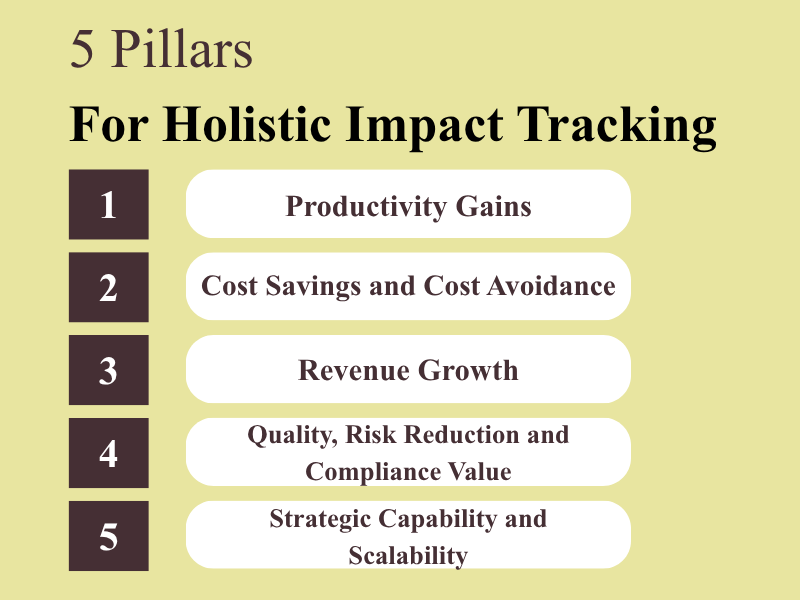
Productivity Gains
Productivity is often the first value category companies look at. It is also one of the easiest to overstate. Useful productivity metrics include:
- Time saved per task
- Cycle time reduction
- Throughput per employee
- Ticket resolution speed
- Report preparation time
- Developer lead time
- QA execution speed
- First-response time
- Average handling time
But there is one important rule: saved time is not automatically saved money.
For example, imagine a finance team of 20 analysts. Before AI, each analyst spends six hours preparing a monthly report. That is 120 hours per month. After introducing an AI-assisted reporting workflow, the same work takes 2.5 hours per analyst, or 50 hours per month.
The gross time saving is 70 hours per month.
That sounds valuable. But the business still needs to answer a few practical questions:
- Were those 70 hours used for higher-value analysis?
- Did reporting become more frequent or more accurate?
- Did leadership make decisions faster?
- Was external consulting spend reduced?
- Did the team increase capacity without adding headcount?
If the answer is no, the ROI may be more theoretical than real.
Productivity gains only become business value when the organization knows what happens to the saved time.
Cost Savings and Cost Avoidance
Cost savings are easier to defend because they connect to a real budget line. If AI reduces invoice processing time, the value must appear in finance operations. If it reduces manual QA effort, the value should appear in software delivery costs or reduced defect correction. Cost avoidance also matters—allowing a growing company to handle double the transaction volume without hiring new staff at the same linear rate.
Revenue Growth
Revenue impact is harder to attribute than cost reduction, but it can be more valuable. An AI sales assistant may not directly close deals, but if it reduces account research time and sharpens lead qualification, the effect appears in shorter sales cycles and conversion rate uplifts. However, attribution needs to be conservative to isolate AI value from general market momentum.
Quality, Risk Reduction and Compliance Value
For companies operating across Switzerland, the EU, the UK, and the US, risk reduction is a core value category, not just a compliance footnote. The EU AI Act uses a strict risk-based classification system. As highlighted in IMT’s AI Act guides, a use case that saves time but increases unmonitored regulatory exposure is not profitable once the costs of legal review, data privacy monitoring, and auditability are factored into the total cost of ownership.
Strategic Capability and Scalability
Some value does not appear in the first quarter. Building reusable data pipelines, MLOps orchestration, and prompt evaluation layers reduces the cost of future AI deployments. This technical equity improves engineering velocity for subsequent use cases, transforming single experiments into a scalable platform investment.
Generative AI and Agentic AI Need Different ROI Models
Adjusting Measurement Criteria for Cognitive vs. Action-Oriented Tools
Application of a single financial yardstick to both basic generative applications and autonomous agentic systems is a fundamental architectural mistake. Generative tools function primarily as cognitive assistants that accelerate content drafting, search, and communication; thus, their ROI must be captured via user-centric speed and quality benchmarks. Conversely, Agentic AI acts as an autonomous operational worker capable of executing end-to-end multi-step workflows across disjointed enterprise platforms. Consequently, agentic ROI must measure workflow completion rates, exception handling, human escalation frequency, and token cost per successful outcome.
A generative AI assistant may help an employee write a report faster, but an agentic AI system completes an entire invoice workflow across CRM, ERP, and internal databases without human prompts. They are completely different measurement problems:
- Generative AI ROI: Best measured via individual task speed, faster first drafts, code assistance impact, and reduced research latency.
- Agentic AI ROI: Best measured via automated workflow completion rates, human intervention frequency, exception rates, and error recovery speed.
A Practical 7-Step AI ROI Measurement Framework for Enterprise Teams
Execution Playbook: The 7-Step Operational Roadmap to Financial Verification
Implementing a rigorous AI ROI measurement framework requires enterprise teams to step away from vendor-defined metrics and establish an independent seven-step operational lifecycle. This framework begins by anchoring every technical build to a specific, measurable business problem rather than an off-the-shelf software capability. By establishing historical baselines, isolating distinct measurement windows, accounting for the true total cost of ownership (TCO), and tracking portfolio use cases on a centralized dashboard, leadership teams can make data-driven decisions to scale, pivot, or retire AI assets based on verified economic performance.
Step 1: Start With a Business Problem
Do not ask: “We bought an AI tool, where can we use it?”. Start with a clear target outcome: reduce invoice processing costs by 25% or compress software release cycle times by 15%. If the team cannot define the underlying business metric, the project is an experiment, not an enterprise asset.
Step 2: Define the Baseline
Without a baseline, ROI becomes corporate storytelling. Teams must pull current operational parameters—cost per task, process cycle times, or defect rates—from system logs, financial reports, or CRM data to give finance and technology teams an agreed-upon starting point.
Step 3: Choose the Measurement Window
Different use cases need different horizons. A text summarization tool may show productivity signals in 30 days, while an agentic workflow tool or an automated sales assistant needs 3 to 6 months to account for exception rates and full sales cycles.
Step 4: Separate Leading Indicators From Business Outcomes
Leading indicators (active users, prompt volume) prove whether the system has a chance to create value. Business outcomes (direct cost savings, revenue uplift) prove whether it actually did. A practical dashboard maps both but never confuses them.
Step 5: Include Total Cost of Ownership (TCO)
Calculations that only count software license fees are highly inaccurate. A realistic financial model must include underlying cloud/inference costs, data pipeline preparation, integration labor, security reviews, training, and continuous MLOps monitoring.
Step 6: Build a Use-Case ROI Dashboard
Enterprises must avoid putting all AI activity into one generic chart. The better approach is a use-case portfolio dashboard tracking specific fields:
| Dashboard Field | Strategic Purpose |
|---|---|
| Use Case Name | Explicitly defines what is being measured. |
| Baseline vs. Target | Displays the starting point vs. expected improvement. |
| Total Run Cost | Includes software licenses plus hidden infrastructure and monitoring costs. |
| Human Review Effort | Measures hidden operating overhead and escalation rates. |
| Decision Status | Direct action indicator: Scale, Improve, Pause, or Retire. |

Step 7: Review, Improve, or Retire
Measurement only matters if it changes corporate investment behavior. A quarterly review must lead to decisive operational actions: scale high-performing code, fix unvalidated data pipelines suffering from drift, or explicitly retire expensive tools that fail to cross financial hurdle rates.
Common AI ROI Measurement Mistakes to Avoid
Enterprise technology history is filled with projects that looked impressive in a steering committee demo but delivered zero economic value. Technology leaders must actively guard against these seven foundational mistakes:
- Measuring Adoption Instead of Outcomes: High tool utilization is a vanity metric if it doesn’t move a core operational performance line.
- Counting Saved Time as Saved Money: Saved labor hours only turn into enterprise value when explicitly converted into higher product capacity, delivery speed, or structural budget reduction.
- Ignoring the Hidden TCO: Software licenses represent a fraction of the budget; cloud inference, integration labor, and compliance review hours must be factored in.
- Evaluating Sandboxes Instead of Production: Clean data pilots rarely replicate the noise, latency, and edge-case exceptions of live systems.
- Making “Vibe-Based” AI Investment Decisions: Vibe-based decisions sound like this: the demo looked impressive, competitors are doing it, and we don’t want to slow down. This is acceptable for a pilot but highly dangerous for enterprise-scale spending.
Why AI ROI Measurement Matters More in Regulated Markets
Regional Governance: Factoring Trust, Compliance, and Compliance Risks into the Financial Equation
In highly scrutinized markets like Switzerland, the UK, and the broader European Union, an AI ROI investment strategy cannot be calculated independently of corporate risk governance. Highly regulated industries—including banking, insurance, and healthcare—face strict, overlapping oversight where operational resilience is tied directly to market access. An automated workflow may look highly profitable on paper, but if its deployment introduces unmonitored shadow AI, violates data residency, or fails to maintain algorithmic auditability, the total cost of compliance mitigation will quickly erase its short-term operational savings.
This intersection of value and validation requires a clear regional awareness:
- Switzerland: High expectations around financial services privacy, trust, and absolute data custody under FINMA guidance require extreme auditability.
- The European Union: The phased milestones of the EU AI Act mandate strict conformity audits and technical logging for high-risk applications, with non-compliance fines reaching up to 7% of global turnover.
- The United States: While the market moves fast on commercial experimentation, enterprise buyers face board pressure and targeted sector enforcement from the FTC based on the NIST framework.
How IMT Solutions Can Support Enterprises with an AI ROI Measurement Framework
For modern scale organizations, the obstacle is rarely choosing a raw model. The true challenge lies in connecting that model to complex business workflows, unvalidated legacy infrastructure, clean data assets, and verifiable performance indicators.
IMT Solutions bridges this operational gap as a trusted technology and product engineering partner. Backed by over 17 years of technical execution, an ISO 27001 security foundation, and extensive cross-border delivery experience, IMT helps enterprises design, execute, and govern their automation roadmaps. We support your value verification lifecycle through:
- AI and Data Engineering: Building clean, validated ingestion pipelines to eliminate model drift and ensure accurate performance tracking.
- Custom Application & Product Development: Designing secure enterprise environments and gateway layers to eliminate shadow AI vulnerabilities.
- MLOps & DevOpsコンサルティング: Integrating continuous monitoring, synthetic alerting, and automated rollback architectures via tools like Foresight – Synthetic Monitoring System.
- 独立系ソフトウェアテスト: Verifying autonomous workflows, testing exception constraints, and running adversarial evaluations to prevent costly production failures.
If your enterprise has already deployed a suite of AI pilots or expensive vendor platforms, the next logical step is not another technology demo. It is an objective AI ROI Audit. Review which initiatives are driving structural business value, which are merely generating adoption metrics, and which require an architectural intervention before they scale.
Explore our Case Studies – IMT Solutions library or connect with our engineering team at Contact IMT Solutions to establish a transparent, auditable framework for your digital transformation journey.
Final Thoughts: The Next Phase of AI Is Accountability
The next phase of enterprise automation will not be won by the organizations that deploy the highest volume of algorithms or activate the most software licenses. The long-term winners will be the companies that treat AI as a core component of a disciplined digital operating model—anchored to clean data, governed by transparent human-in-the-loop controls, and verified by an independent AI ROI measurement framework. AI adoption was phase one; financial accountability is the step that decides whether your investment deserves to scale.
FAQ
What is an AI ROI measurement framework?
An AI ROI measurement framework is a structured way to connect AI investments to business outcomes such as cost savings, productivity gains, revenue growth, risk reduction, and operational efficiency. It helps organizations move beyond adoption metrics and prove whether AI is creating measurable value.
Why are AI adoption metrics not enough?
AI adoption metrics show whether people are using a tool, but they do not prove business value. A company may have high AI usage and still see no improvement in cost, revenue, quality, or productivity.
What are the best metrics for measuring AI ROI?
Useful AI ROI metrics include time saved per workflow, cost per task, revenue uplift, cycle time reduction, error rate reduction, support resolution speed, defect reduction, compliance exception rate, and human review effort.
How is agentic AI ROI different?
Agentic AI ROI should focus on end-to-end workflow completion, automation rate, exception rate, human intervention rate, cost per successful task, auditability, escalation accuracy, and process cycle time.
What is the biggest AI ROI mistake?
The biggest mistake is treating adoption as value. Usage is only a signal. ROI depends on whether AI changes a business outcome that finance, operations, technology, and leadership teams agree is meaningful.
When should an enterprise run an AI ROI audit?
An enterprise should run an AI ROI audit when it has multiple AI pilots, unclear business value, rising license costs, shadow AI usage, or pressure from leadership to justify further investment.