Risk Management in Autonomous Testing: How to Scale AI Validation Without Losing Control
Who is accountable when AI approves a faulty release?
Autonomous testing promises faster delivery, shorter validation cycles, and less manual effort. When automated decisions directly affect production environments, establishing a strict framework for Autonomous Testing Risk Management becomes an essential part of software quality. Most leadership teams look at AI validation purely as a tool to expand technical speed. They want to ship features faster and clear out testing backlogs. But if your team accelerates execution without updating its software testing governance, you risk introducing invisible flaws into your primary applications.
Faster validation must never mean lower accountability. The reality of modern engineering is that smart tools can draft test cases, execute regressions, and analyze system data at a speed humans cannot match. However, tools cannot carry corporate or legal liability when a system crash happens in a live production environment.
Autonomous testing becomes truly valuable only when corporate leaders can explain, override, and audit every automated decision. Balancing delivery pressure with operational safety requires a controlled automation strategy. This guide outlines how enterprise organizations can scale their quality engineering pipelines while maintaining strict human oversight, audit readiness, and release governance.
1. Why Is Autonomous Testing Risk Management Essential for Modern Enterprise Teams?
Managing Hidden Decisions Under High Delivery Speed
When an organization embeds artificial intelligence deep within its software verification channels, it alters how development decisions are made. Traditional workflows rely on explicit, hand-written testing scripts that human engineers can easily read and verify. An automated validation pipeline introduces probabilistic analysis models that operate behind the scenes. Without a dedicated governance framework, your primary delivery loops can become a black box, making it difficult for technical managers to track production risk.
As release cycles shrink, the operational pressure on quality teams escalates. Organizations deploy intelligent coding tools to generate features quickly, which instantly inflates the volume of code changes waiting at the deployment gate. To keep up, engineering units apply AI validation to scan pull requests and run automated regression suites. This setup creates immense delivery speed, but it also creates a major governance gap if your team treats machine feedback as an absolute release approval.
The hidden risk is that automated tools can sound incredibly confident even when they are completely wrong. If an engineering manager relies blindly on tool logs without enforcing a clear exception-based review model, minor logic flaws can slip through to your live production channels.
True Autonomous Testing Risk Management ensures that your organization does not delegate final release authority to an algorithm. By hardcoding automated safety checkpoints directly into your repositories, your leadership can leverage machine velocity while keeping technical teams personally accountable for system stability.

2. Defining the Real Operational Bounds of Autonomous Testing Risk Management
Balancing Automated Assistance with Human-in-the-Loop Safeguards
To implement a reliable quality engineering framework, corporate steering committees must separate actual technical capability from marketing hype. Choosing to prioritize Autonomous Testing Risk Management is not an anti-AI stance, nor is it a strategy designed to slow down your product roadmap. Instead, this operational capability focuses on building a structured, auditable testing pipeline where human professionals guide strategy while machine intelligence handles repetitive execution tasks.
A mature AI QA governance strategy defines clear operational limits for automated software testing. The platform functions as an intelligent assistant that handles high-volume pattern scanning, initial script scaffolding, and rapid log sorting. However, the system is configured to flag exceptions, highlight ambiguous results, and measure confidence thresholds. If an automated check scores below a pre-set security baseline, the workflow halts the pipeline and alerts a human reviewer, ensuring that your core deployment channels remain safe and fully managed.
3. Five Critical Flaws Leaders Underestimate Without Autonomous Testing Risk Management
Enterprise technology historical trends prove that deploying automated validation tools without explicit oversight structures introduces five distinct operational liabilities:
- The Exposure of False Positives: Automated validation systems can generate misleading error alerts due to unstable environments or minor interface changes, creating unnecessary alerts that stall development speed.
- The Threat of False Negatives: An automated tool might clear a code modification because the text syntax compiles perfectly, completely missing a deep business logic flaw or a severe security exposure.
- Weak Audit Trail Visibility: Scaling AI-generated test cases without logging how a model reached a specific validation recommendation leaves the firm vulnerable during strict regulatory compliance reviews.
- Blind Automation Trust: When software teams assume that an intelligent system has cleared a pull request of defects, they naturally lower their manual audit standards and skim through complex modifications.
- Ownership and Accountability Confusion: Failing to define exactly who owns a release decision when an automated tool recommends deployment, leading to a breakdown in operational discipline.
4. Why Human Overrides Must Remain Central to Software Testing Governance
Enforcing Explicit Boundary Rules and Verification Thresholds
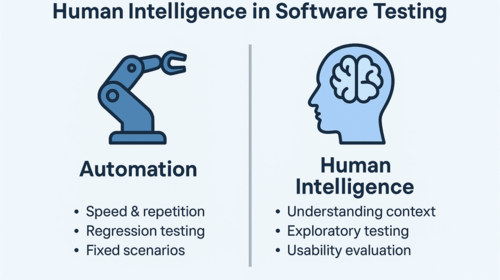
Machine models excel at processing high-scale, structured data arrays, but they remain fundamentally blind to product intent, brand reputation risks, and customer contract commitments. To build a secure and resilient software release architecture, enterprise leaders must implement an exception-based decision framework. Enforcing strict human-in-the-loop validation parameters ensures your most vital digital assets are continuously guarded by experienced professionals.
Successful release governance requires establishing clear boundaries that dictate when an automated platform can proceed independently and when a human engineer must step in. This model relies directly on real-time confidence thresholds. When an automated testing loop validates a low-risk change—such as an internal layout update or a simple text formatting edit—the pipeline can move forward automatically.
However, if a code change touches a sensitive system boundary (such as identity authentication flows, payment clearing lines, or regulated health databases), human-in-the-loop testing remains mandatory. Quality architects apply their context-heavy judgment to evaluate the system impact, check test quality, and provide the final human sign-off before code transitions to live servers.
5. Constructing Reliable Audit Trails to Minimize AI Testing Risk
If a software release cannot be fully explained later during a system review, it was never fully governed. For enterprise organizations, creating a comprehensive data log is an essential requirement to maintain regulatory compliance and customer trust. When your quality engineering pipeline utilizes machine learning to select and execute scripts, your automated infrastructure must log every step of the validation path.
A resilient audit trail testing framework captures a complete technical record for every deployment:
- The Inputs Used: Recording the exact version of the product requirements, source code diffs, and schema metrics fed into the automated system.
- The Model Telemetry: Logging the specific version of the AI engine used to generate the test cases or prioritize the regression suite.
- The Decision Metrics: Storing the calculated confidence thresholds, change impact analysis signals, and automated verification logs.
- The Human Verifications: Documenting exactly who reviewed the automated suggestions, what overrides were applied, and who authorized the final merge.

6. A Practical 5-Stage Operating Model for Safe Autonomous Testing
To implement an optimized, secure quality framework without disrupting your daily delivery milestones, corporate leaders should follow a structured five-stage rollout playbook:
- Stage 1: Observe (Baseline Telemetry): Deploy your automated testing tools in a silent, passive monitoring mode. Allow the system to scan your code changes and generate test suggestions without executing them automatically, helping your team baseline model accuracy against your current manual processes.
- Stage 2: Recommend (Decision Support): Transition the platform to act as a clear decision-support utility. The system crafts test suites, identifies duplicate bugs, and recommends severity rankings, but requires explicit human approval to execute any pipeline action.
- Stage 3: Approve (Automated Quality Gates): Integrate the prioritized validation loops directly into your release channels. Low-risk changes are managed automatically by the system, while medium-to-high-risk paths stop at mandatory quality gates for human architect sign-off.
- Stage 4: Automate (Continuous Execution): Allow the platform to manage routine regression sweeps, self-heal minor locator breaks, and analyze standard failure logs independently, freeing team capacity for complex engineering tasks.
- Stage 5: Optimize (Continuous Learning): Evaluate your system performance logs monthly. Analyze how often human managers override model classifications, and use these corrections to continuously refine your risk scoring and pipeline governance policies.
7. Balancing Regional Regulations and Compliance Frameworks with AI QA Governance
For multinational technology companies, managing code validation is not an informal technical shortcut; it is a core legal compliance requirement. When software environments process customer data, support financial transactions, or operate in highly scrutinized fields, your validation pipelines must adhere to regional legal expectations from day one.
Distributed technical units must navigate distinct geographic regulations:
- The Swiss Environment: Known for high-security, trust-reliant fields like private banking, wealth management, and enterprise technology, Switzerland enforces strict data custody and operational resilience standards under FINMA oversight. Software tracking here requires absolute audit readiness and clear data lineage records, ensuring that automated setups never introduce untraceable data-handling paths.
- The European Market: Operating within the European landscape requires direct alignment with data protection codes and the strict regulatory frameworks of the EU AI Act. The Act applies to global firms if their automated software outputs affect individuals within the EU, demanding transparent technical logging, conformity assessments, and clear human-in-the-loop overrides for high-risk systems.
- The United States & UK: Development units face intense pressure from corporate boards to align their secure software development lifecycle with the NIST AI Risk Management Framework, demanding secure API validation, risk mitigation mappings, and transparent threat modeling.
8. Business Metrics to Verify Autonomous Testing Risk Management Value
Engineering managers should never measure the value of a quality transformation initiative by tracking superficial tool activity logs. Telemetry showing active software seats, daily prompt volumes, or the total count of test files created by an engine does not prove that your enterprise is operating more securely. Real value tracking requires measuring system-level outcomes that balance delivery speed with release safety.
An enterprise operations dashboard must prioritize hard quality and efficiency metrics popularized by global DORA software delivery research:
- False Positive and Override Rates: Tracking how often human managers must correct or reject automated recommendations, which highlights tool accuracy trends.
- Defect Escape Rate: Monitoring the percentage of critical software bugs or logic flaws slipping past automated quality gates into live production environments.
- Approval Latency Duration: Measuring the total time a high-risk ticket spends waiting in a validation queue before receiving human sign-off.
- Change Failure Rate: Quantifying the percentage of live software releases that trigger immediate system degradation or require an immediate hotfix rollback.
- Mean Time to Recovery (MTTR): Tracking how fast your technical squads can isolate, diagnose, and recover from live production outages using automated failure logs.
9. How IMT Solutions Helps Organizations Scale Autonomous Testing Risk Management
Achieving sustainable release acceleration through intelligent validation is not a simple tool deployment challenge. It is a comprehensive system transformation that demands extensive expertise in test automation design, legacy application modernization, DevOps optimization, and global risk compliance.
IMT Solutions acts as a trusted digital transformation and software engineering partner, helping enterprises design, build, và optimize secure-by-design automation frameworks under strict ISO 27001-certified security standards.
If your software delivery pipeline is acting as a major release bottleneck, or your teams are concerned about the hidden security risks of automated coding tools, it is time to upgrade your framework. An independent readiness review can help your leadership team optimize DevOps workflows, improve automated testing coverage, mitigate technical debt, and establish real value verification before you scale spending further. Explore our latest integration approaches in Blogs – IMT Solutions, analyze our live delivery history in Case Studies – IMT Solutions, or connect with our platform specialists at Contact IMT Solutions to advance your software lifecycle with absolute confidence.
10. Conclusion
Autonomous testing does not remove human accountability from software delivery; it changes exactly where that accountability lives. Moving away from manual checklists to embrace machine-accelerated validation is a powerful way to reduce operational waste and drive market velocity. However, scaling these advanced tools successfully requires an unwavering commitment to risk management, clear governance thresholds, and comprehensive audit visibility.
The long-term winners of the digital transformation era will not be the companies that blindly trust machine outputs to save manual labor hours. The organizations that capture a sustainable competitive advantage will be those that use automated tools to optimize their entire quality engineering lifecycle with absolute discipline, clarity, and system-level control. Automate the sorting, keep accountability with the team.
FAQ
Who owns the final release approval decision in an autonomous testing environment?
Final release approval remains strictly human-owned. Automated platforms provide rapid quality signals, change impact analysis data, and technical recommendations, but the ultimate accountability for shipping code to production belongs to your engineering leads and product owners.
Can automated tools safely approve production releases independently?
Only for clearly defined, low-risk changes like simple internal layout formatting or documentation edits. Any software modification that touches business logic, identity authentication protocols, secure payment lines, or sensitive customer data must be routed through human review paths.
What primarily causes false positives in automated validation pipelines?
False positives typically stem from unstable testing environments, poorly configured element locators, outdated test data configurations, or unmanaged user interface layout changes that cause automated scripts to trigger false-alarm alerts.
How much human review is enough when scaling an AI QA framework?
The ideal balance relies on a risk-based model. By setting clear confidence thresholds, your team automates 80% of routine, low-risk verification tasks, allowing your senior architects to focus 100% of their focus capacity on the remaining 20% of high-risk corporate assets.
How do comprehensive audit trails actively reduce software testing risk?
Audit trails capture an unalterable technical record of every code input, model version, confidence score, and human override applied during the release cycle. This complete visibility simplifies regulatory compliance verification and speeds up root-cause diagnosis during live production incidents.